About Sawai Madhopur District (Rajasthan)
In ancient India the region was more popularly known as Ranthambore later called Sawai Madhopur. Sawai Madhopur is a planned city which was founded by Maharaja Sawai Madho Singh I of Jaipur 1763. He named the township after himself. The history of Sawai Madhopur revolves around the Ranthambore fort. The settlement around the fort is the oldest here. According to popular belief, this fort was built by Rajput King Sapaldaksha in the year 944 AD. He belonged to the Chauhan clan. In 1300 AD Ala-ud-din Khilji, the Afghan ruler captured Delhi. He sent his troops to capture Ranthambore too but failed three times. Finally in 1301, he conquered the fort. Akbar in 1558 merged Ranthambore with his kingdom. The Mughal rulers ruled the fort till 18st century. Later during the period of British rule, Sawai Man Singh constructed a railway line to connect Jaipur and Sawai Madhopur. Due to which, it became easily accessible from the heart of the state of Rajasthan. The place of Sawai Madhopur was transferred to a planned city by Maharaja Sawai Madho Singh I of Jaipur with the help of his creative skills on 19st January 1763 and he named the township after himself. That’s why on 19st January of every year, the entire Sawai Madhopur celebrates its foundation day.
Mr. Ram Gopal Verma is a veteran Indian Painter who born in the year 1905 at Baler in the district of Sawai Madhopur. He was the principal of Rajasthan Kala Mandir and Rajasthan School of Art from 1945 to 1966. He got awards named Maharaja Patiala in 1934, Rajasthan Lalit Kala Akedemi in 1958 and 1988 respectively, Padam Shri Award in 1984 and Sahitya Vachaspati in 1998.
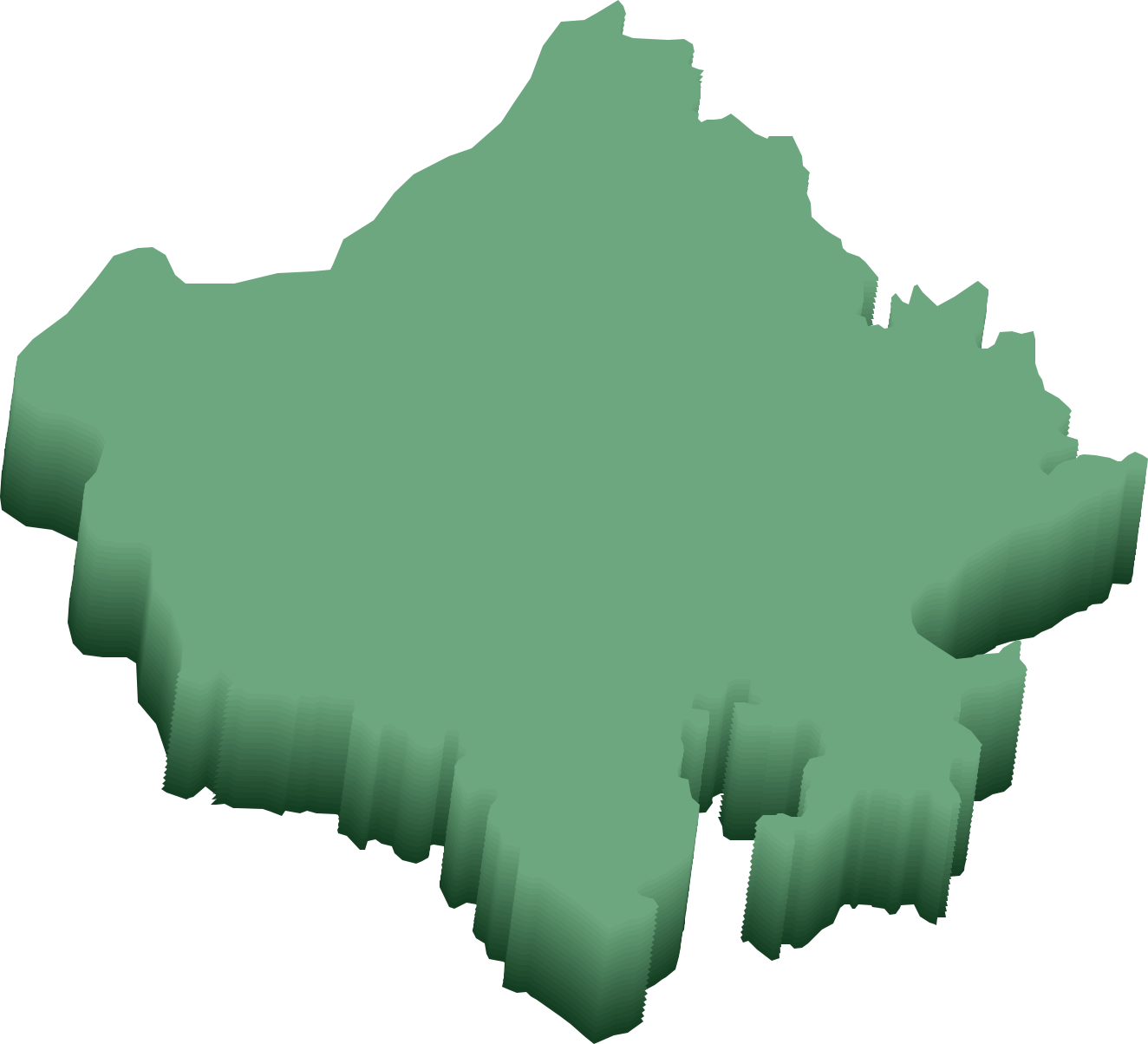
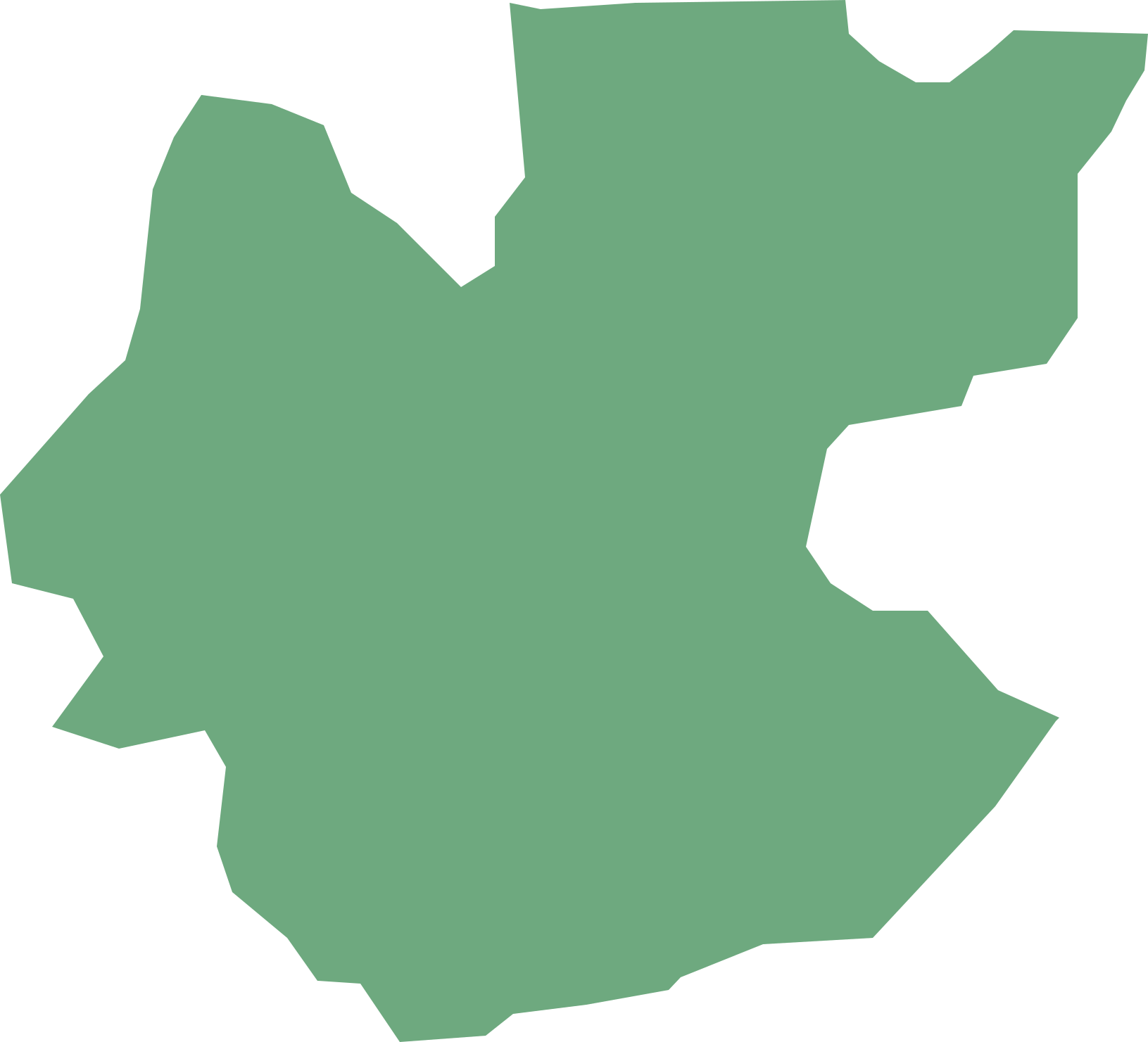
Geographically, the district comprises of 4,498 sq km. total geographical area. In the year 2023, there was a total 10.29% forest area of total geographical area. According to the census of 2008-09, the region had total 809.10 sq km. wasteland. It lies at 26°02'N latitude, 76°34'E longitude and 344 m altitude. The district is bounded by Dausa district on the north, Karauli district on the northeast, Jaipur district on the Northwest, the Chambal River on the east across the border of Madhya Pradesh state, Kota district on the South East, Bundi district on the South and Tonk district on the West. There are hills and broken ground in the South and South East portion and range of Aravali hills in the Northern Western and Southern part of the district. The region has dry climate with distinct winter and rainy season. Banas, Moral and Chambal are main rivers that passes through the district. Banas is the longest one among them. The region has partly plain and partly hilly terrain. The plain is fertile and then soil in the most parts is light and sandy. The district comprises of a variety of mineral resources both metallic and non-metallic. Metallic resources include lead, copper and iron ore whereas the non-metallic minerals include limestone, clay, silica sand and slate. Red-oxide, manganese sand and bricks clay, etc are other minerals which are found here. Land in the region is formed by pre- Cambrian Metamorphic, ligneous and sedimentary Aravali hills. The district is well connected with neighboring districts and major cities outside the state. There are NH116 (Tonk-Sawai Madhopur Road) and Kota-Lalsot Mega Highway in the region. The climate of the district is extremely hot in the summers and fairly cold in the winters. Most of its rainfall occurs in the monsoon season. The actual rainfall in the district was 1328.5 mm in the year of 2024-2025.
Administratively, the district has 7 sub-districts namely Sawai madhour, Chauth ka Baewara, Khandhar, Bonli, Malarna Dungar, Gangapur city and Bamanwas. Moreover, the district has 4 towns and 814 villages. The administrative language in the district is Hindi.
According to 2011 census, the district is home to a total number of 2,53,987 households with a total population of 13,35,551 out of which 7,04,031 are males and 6,31,520 are females respectively which led it to the ranks of 26th in the state and 363 in India. The density of population of the district is 297 persons per sq km. The sex ratio is 897 (females for every 1000 males) while the child ratio stands at 871 (females per 1000 males). In the year 2001-2011 the population growth rate in the district was 19.56% out of which 19.06% were males and 20.12% were females. Furthermore, the district has projected population of 16,28,691 comprising 8,59,685 males and 7,69,006 females for the year 2026. According to the National Family Health Survey (NFHS-5, 2019–21), the district has an estimated sex ratio of 999 females and a child sex ratio of 775 females per 1,000 males. As per 2011 census the percentage of the principal language in the district is Hindi with 96.48%. According to 2011 census the major religions in the district are Hindu and Muslim with 87.27% and 11.66% of the total population. In the year 2023 the number of live births in the district was 37,100 out of which 19,849 were males and 17,249 were females. In the same year the number of deaths in the district was 7,500 out of which 4,456 were males and 3,044 were females.
Economically, it is one of the most backward districts, receiving Backward Relief Grant Fund (BRGF). Agriculture is the main source of income of the people in the region. In the year 2023-2024 the Gross Domestic Product in the district was Rs. 22,94,300 lakh at current price and Rs. 12,39,657 lakh at constant 2011-2012 prices. The Net Domestic Product in the district during the period 2023-2024 was Rs. 20,79,138 lakh at current price and Rs. 11,02,316 lakh at constant 2011-2012 prices. The Per Capita Income or NDDP, At Factor Cost in the district during the period 2023-2024 was Rs. 1,30,883 at current price and Rs. 69,391 at constant 2011-2012 prices. The district has various types of industries such as agro based, cotton textile, wood based furniture, chemical based, mineral based, engineering units and repairing and servicing industry.
According to 2011 census, the literacy rate in the district is 65.39% including 81.51% are males and 47.51% are females. In addition, according to the Periodic Labour Force Survey (PLFS) for the period July 2023-June 2024 estimated literacy rate in the district is 75.48% including 90.58% are males and 58.31% are females (Age 7 Years and Above).
On September 1st, 2015, the Government of India approved to set up a new institute of hotel management at Sawai Madhopur to develop hospitality sector and to promote the tourism named Institute of Hotel Management. College of Engineering and Technology, Sawai Madhopur was established in the year 2013. Now, it is a leading centre to train high quality professional and to provide technical education in the state of Rajasthan. Fateh Public School was established in 2001. It is managed by Prakratik society which was founded in 1994. Jawahar Navodhya Vidhyalaya, Sawai Madhopur is established to provide good quality education, awareness of environment and physical education to the students. Some other institutes are Government Polytechnic College, Bright Sun Public school etc.
Mr. Namo Narain Meena is a famous politician who born at Bamanwas in the Sawai Madhopur on Decembrer 24st, 1943. He served as Minister of State and as Union Member in the Ministry of Finance in the Government of India.
There are a number of attractive places to visit such as Ranthambhore National Park and Tiger Reserve, Dushmeshwar Mahadeo Temple, Chamatkar Temple, Amareshwar Mahadeo Temple, Chauth Mata Temple, Sametonki Haveli, Rameshwaram Ghat, Toran Dwar, Sawai Man Singh Sanctuary, Surwal Lake, Ranthambhore Fort, Khandar Fort, Jogi Mahal, Padam Talab, and Khandar Fort. During the year 2024 there were 1,52,83,450 domestic tourists and 70,133 foreign tourists who visited these places of the district.