About Rajsamand District (Rajasthan)
Historically, Rajsamand is named after Rajsamand Lake which was created in the 17th century by Rana Raj Singh of Mewar. It is an artificial lake. Rajsamand also saw the vicissitudes of the freedom struggle between Tantya Tope and the British troops at 'Rakam garh kachhapar' in 1857. Rajsamand is a rich district regarding history, religion, and culture and mining industries. Haldighati is very famous place of the district.
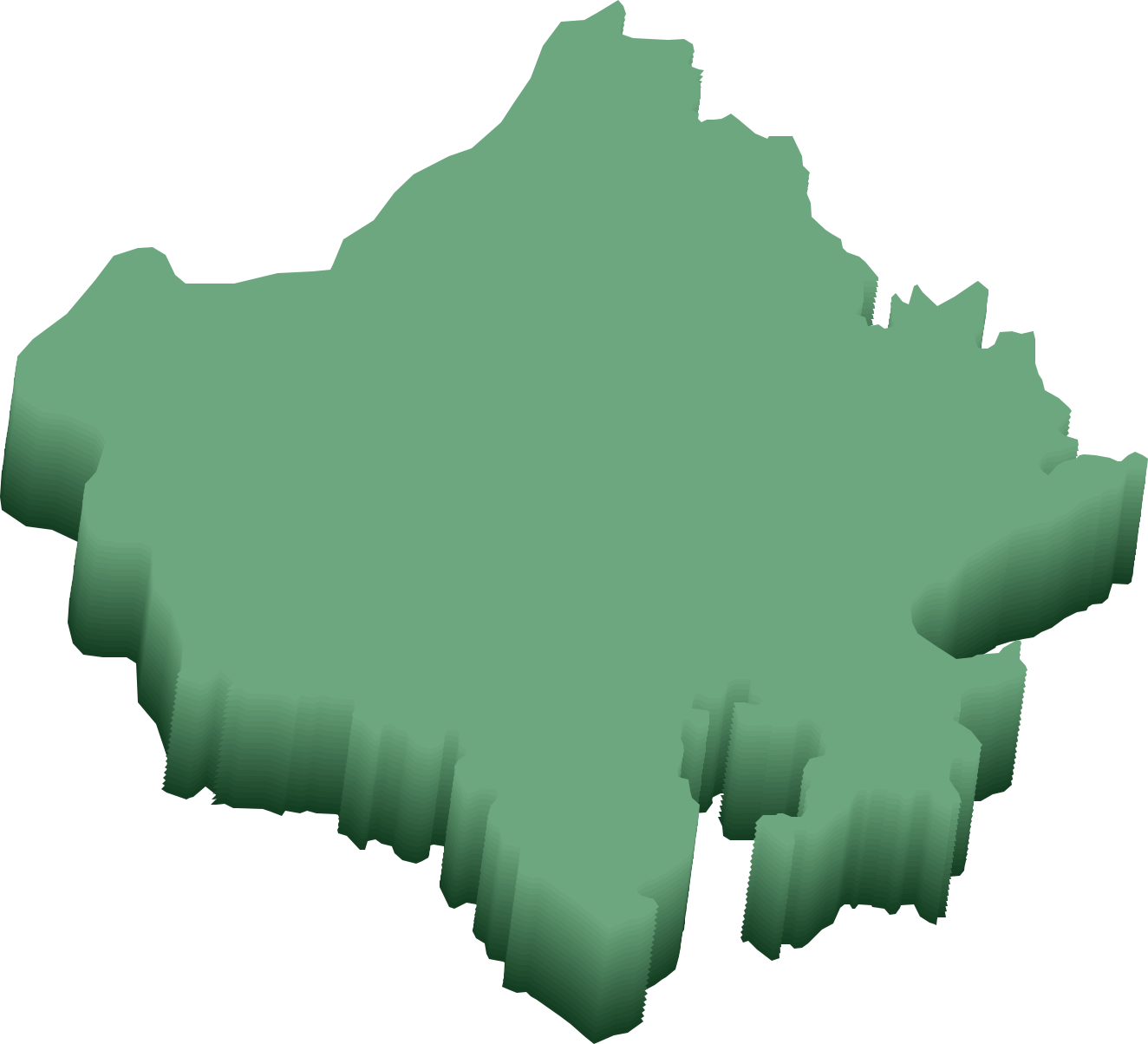
Geographically, the district extends to a geographical area of 4,655 sq. km. and occupies the ranks 27th in the State and 248th in India on basis of this size. As per data recorded in the year 2023, there was a total 11.11% forest area of the total geographical area of the district. It lies 25007'N latitude, 73088'E longitude and 547 m altitude. The district is bounded by the Aravalli Range on the North-Western, and Pali District, Ajmer District on the North, Bhilwara District on the North-East and East, Chittorgarh District on the South-East, and Udaipur District on the South. The Ari, Gomati, Chandra and Bhoga, Banas River and tributaries of Banas River pass through the district. The climate of the district is extremely hot in the summers and fairly cold in the winters. The actual rainfall in the district was 831.0 mm in the year of 2024-2025.
Administratively, the district is divided into 7 sub-districts. Moreover, it has 9 towns and 1,050 villages. The district of Rajsamand came into existence in the year 1996 in the state of Rajasthan with an allotted district code of 123. Its district Headquarter is at Rajsamand which is located at a distance of 334 km. from the State Capital. Hindi is its administrative language.
Demographically, according to 2011 census, the district has a total number of 2,45,488 households with a total population of 11,56,597 including 5,81,339 are males and 5,75,258 are females which causing it to rank 29th in the state and 405 in India. The population growth rate during the period 2001 to 2011 was 17.18% out of which 17.81% were males and 16.55% were females. The density of population of the district is 248 persons per sq km. The sex ratio is pegged at 990 (females per 1000 males) while the child ratio stands at 903 (females per 1000 males). Furthermore, the district has projected population of 14,10,459 comprising 7,09,963 males and 7,00,496 females for the year 2026. According to the National Family Health Survey (NFHS-5, 2019–21), the district has an estimated sex ratio of 1,065 females and a child sex ratio of 894 females per 1,000 males. As per 2011 census the percentage of different religion practiced by the people of this region is Hindu with 95.60% of the total population. According to 2011 census the principal language in the district is Hindi with 99.48%. In the year 2023 the number of live births in the district was 33,774 out of which 17,903 were males and 15,868 were females. In the same year the number of deaths in the district was 9,379 out of which 5,546 were males and 3,831 were females.
Economically, agriculture is the prime base of the district. Mining is other main source of income for the people of the district. Marble, granite and other valuable varieties of stone are found on a large scale. The principal Indian sources of ores for zinc, silver, manganese are Dariba and Jawar mines in the district. Tyre and tobacco factories are also some other industries which are found here. In the year 2023-2024 the Gross Domestic Product in the district was Rs. 27,95,378 lakh at current price and Rs. 18,13,766 lakh at constant 2011-2012 prices. The Net Domestic Product in the district during the period 2023-2024 was Rs. 24,99,767 lakh at current price and Rs. 15,61,614 lakh at constant 2011-2012 prices. The Per Capita Income or NDDP, At Factor Cost in the district during the period 2023-2024 was Rs. 1,81,709 at current price and Rs. 1,13,514 at constant 2011-2012 prices.
Education wise, according to 2011 census, the literacy rate in the district is 63.14% out of which 78.42% are males and 47.95% are females. The total literate population of the district is 6,19,139 including 3,83,334 are males and 2,35,805 are females. The total number of illiterate person is pegged at 5,37,458 out of which 1,98,005 are males and 3,39,453 are females. In addition, according to the Periodic Labour Force Survey (PLFS) for the period July 2023-June 2024 estimated literacy rate in the district is 78.32% including 83.18% are males and 75.03% are females (Age 7 Years and Above).
The district has various primary, higher and secondary schools and colleges.
The district has various historical and religious places which are great attractions for tourists. During the year 2024, there were 51,32,955 domestic tourists and 31,158 foreign tourists who visited the district the main attractions are Kumbhal garh Wildlife Sanctuary, Sri Dwarkadhish Temple, Lake Pichola, Shree Chhapariya Bheru Mandir, Rajsamand Lake, Sanwaria Seth Temple, Haldi Ghati, Chetak Tomb, Arsi Vilas, Kankroli, Kumbhalgarh Fort, and SahityaMandal Library. Haldighati lies in the Aravalli Range of Rajasthan connecting Rajsamand and Pali districts. It is the witness of the famous Battle of Haldighati which occurred in 1576 between the Kingdom of Mewar and the Mughal Army. Charity rose product and the mud art of Molela are famous products of the region. Rajsamand Lake is situated near the town of Rajsamand in the Indian state of Rajasthan. It was built in the 17th century. It is drained by river Gomti. It was by Maharana Raj Singh in 1660. Kumbhalgarh Fort lies in Aravalli Hills. It was built in the 15th century by Rana Kumbha and enlarged through the 19th century. It is also the birthplace of the great king Maharana Pratap. The fort has honor to be the second largest wall in the world after the Great Wall of China and the second largest fort in Rajasthan after Chittorgarh Fort.