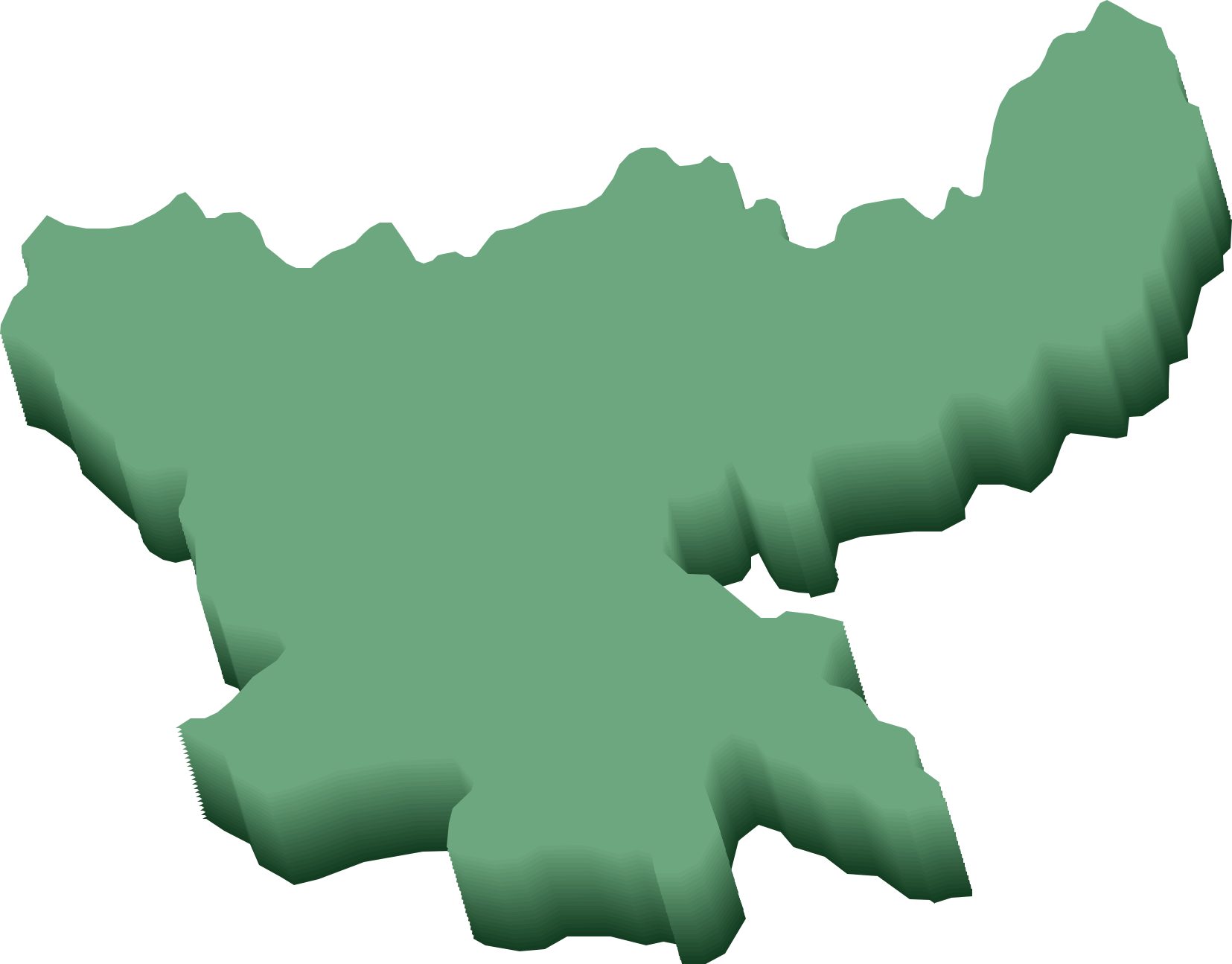
About Godda District (Jharkhand)
Godda district, a part of the Santhal Pargana division is a district of the Jharkhand state with its administrative headquarters located at Godda town. There is no any specific and systematic document regarding the history of the district. But a few numbers of stone weapons and some tools like axes, hammers, arrow-leads or agricultural implements are found in the division of the district which has proved the existence of human life in the region during the period of Stone Age and also during the early Vedic age. The place was ruled by Mughals and many Muslim rulers from different parts of the world for a long period of time. Earlier, Godda was not a separate district but a part of undivided Santhal Pargana district until the year 1981. Later the place, Godda was emerged as a separate district in the map of Jharkhand state on 25th May, 1983.
Geographically, the district lies at 24°83'N latitude and 87°21'E longitude. The altitude in the district is 145 m. In the year 2023, there was a total 19.00% forest area of total geographical area. The district encompasses a geographical area of 2,266 sq kms. and it is bounded by Bihar on the North and West, Dumka district on the South and Sahibganj district and Pakur District on the East. The principal rivers in the district are Sunder, Kajhia, Harna, Tribeni, Doi, Geruwa, Kauwa and Gumani. But almost all its rivers dry up by the end of rainy season, then it appear like some mere beds of sand with a little or no water. The climate of the district is characterised as of diverse nature. Most of its rainfall occurs in the monsoon season. The actual rainfall in the district was 1086.9 mm in the year of 2024-2025.
Administration wise, the district is divided into 9 blocks namely Boarijore, Godda, Mahagama, Meharama, Pathargama, Poraiyahat, Sunderpahari, Thakurgangti and Basantrai. Moreover, it comprises 3 towns and 2,302 villages. The administrative language in the district is Hindi.
According to 2011 census the district has a population of 13,13,551 out of which 6,77,927 are males and 6,35,624 are females. The district has a sex ratio of 938 (females for every 1000 males). Furthermore, the district has projected population of 16,01,863 comprising 8,27,859 males and 7,74,004 females for the year 2026. According to the National Family Health Survey (NFHS-5, 2019–21), the district has an estimated sex ratio of 1,012 females and a child sex ratio of 933 females per 1,000 males. During the year 2001-2011 the population growth rate in the district was 25.35% including 24.61% were males and 26.14% were females. As per 2011 census the major religion in the district is Hindu with 71.34% of the total population. The population density in the district is 580 (persons per sq kms.). As per 2011 census the principal languages in the district are Hindi, Santali and Urdu with 64.73%, 20.60% and 8.40%. Godda is renowned as the land of a tribe called Santhals. Godda is not only a land of tribes but also a land of the non-tribal and urban people. In the year 2023 the number of live births in the district was 36,629 out of which 19,076 were males and 17,550 were females. In the same year the number of deaths in the district was 4,517 out of which 3,171 were males and 1,346 were females.
The economy of the district is mainly dependent on both the agricultural and industrial sectors. Most of the population in the district are engaged in agriculture in order to earn their livelihood. The chief agricultural products in the district are paddy, wheat and maize. The district is fortunate enough to have the Rajmahal coalfield located at Lalmatia in the district. The coal mine present in the place is an integral part of ECL coalfields. Furthermore it is among the biggest in whole Asia. Earlier, it was a remote place, full of woods and out of reach from science and technology. The complete scenario of the place has changed after the discovery of abundance coal under the Rajmahal Hills by a team of the Geological Survey of India. Very soon two more opencast coal mine of Eastern Coalfields Limited namely Chuperbhita opencast coal mine project and Hurra 'C' opencast coal mine project will come to the Godda district. In 2006 the Indian government declared Godda as one of the country's 250 most backward districts and currently receiving funds from the Backward Regions Grant Fund Programme (BRGF). In the year 2021-2022 the Gross Domestic Product in the district was Rs. 11,33,207 lakh at current price and Rs. 7,61,040 lakh at constant 2011-2012 prices. The Net Domestic Product in the district during the period 2021-2022 was Rs. 12,43,974 lakh at current price and Rs. 8,93,445 lakh at constant 2011-2012 prices. The Per Capita Income or NDDP, At Factor Cost in the district during the period 2021-2022 was Rs. 80,594 at current price and Rs. 57,884 at constant 2011-2012 prices.
The district is well known as an abode of several reputed educational institutions. It provides a platform for higher education. Some of its most recognised educational institutions are DAV Public School, Jawahar Navoday School, Delhi Public School, St. Josephs School, St. Thomas School, St. Micheal Anglo Indian School, Gyan sthali public school, etc. It has also some prominent colleges which offer courses in different fields. Most of the colleges in the district are affiliated to Siddu Kanhu Murmu University, situated at Dumka in the district. As per 2011 census the literacy rate in the district is 56.4% including 67.84% are males and 44.14% are females. The total number of literates in the district is 6,04,519 out of which 3,76,212 are males and 2,28,307 are females. In addition, according to the Periodic Labour Force Survey (PLFS) for the period July 2023-June 2024 estimated literacy rate in the district is 82.13% including 88.03% are males and 76.59% are females (Age 7 Years and Above).
Bhagwat Jha Azad, a veteran Indian politician and the former chief minister of Bihar from 14th February, 1988 to 10th March, 1989 was born at Kasba village at Mehrama in Godda district on 28th November, 1922. He also served as a Union minister of state from 1967 to 1983 in the different ministries likewise ministries of agriculture, education, labour and employment, supply and rehabilitation, civil aviation and food and civil supplies. Rameshwar Thakur, an illustrious senior politician of the Indian National Congress and the former Governor of Madhya Pradesh from 2009 to 2011 was born on 28th July, 1924 at Thakur Gangti Village in the Godda district. He also served as the Governor of Odisha from 2004 to 2006, Andhra Pradesh from 2006 to 2007 and Karnataka from 2007 to 2009.
The district has several centres of attraction which allures many travellers from different parts of the country as well as world. Sundar Dam, the biggest irrigational project in this district is constructed on Sundar River near Rajabhitha village in the north-eastern part of the Pathargama. It is a perfect destination for nature’s lovers and also a beautiful picnic spot. Mullers Tank, made by Fredrick Max Muller is located in the district headquarter. Yogini Shakti Peeth, situated at the distance of 2 kms. from Pathergama near Lakhanpahari village is a sacred place of the region. Natives of the district believe that when Lord Shiva started Tandava Nirtya by carrying the charred body of Sati then the thigh of Sati Uma is to have fallen in the place and in due course of time the temple is built here. Basantrai, a place where Raja Basant Rai was inhabited is located 12 kms. away from the headquarters of Pathergama Block. According to legend, till today no one has been able to cross the tank whether by swimming or an elephant or in a boat from one end to another.