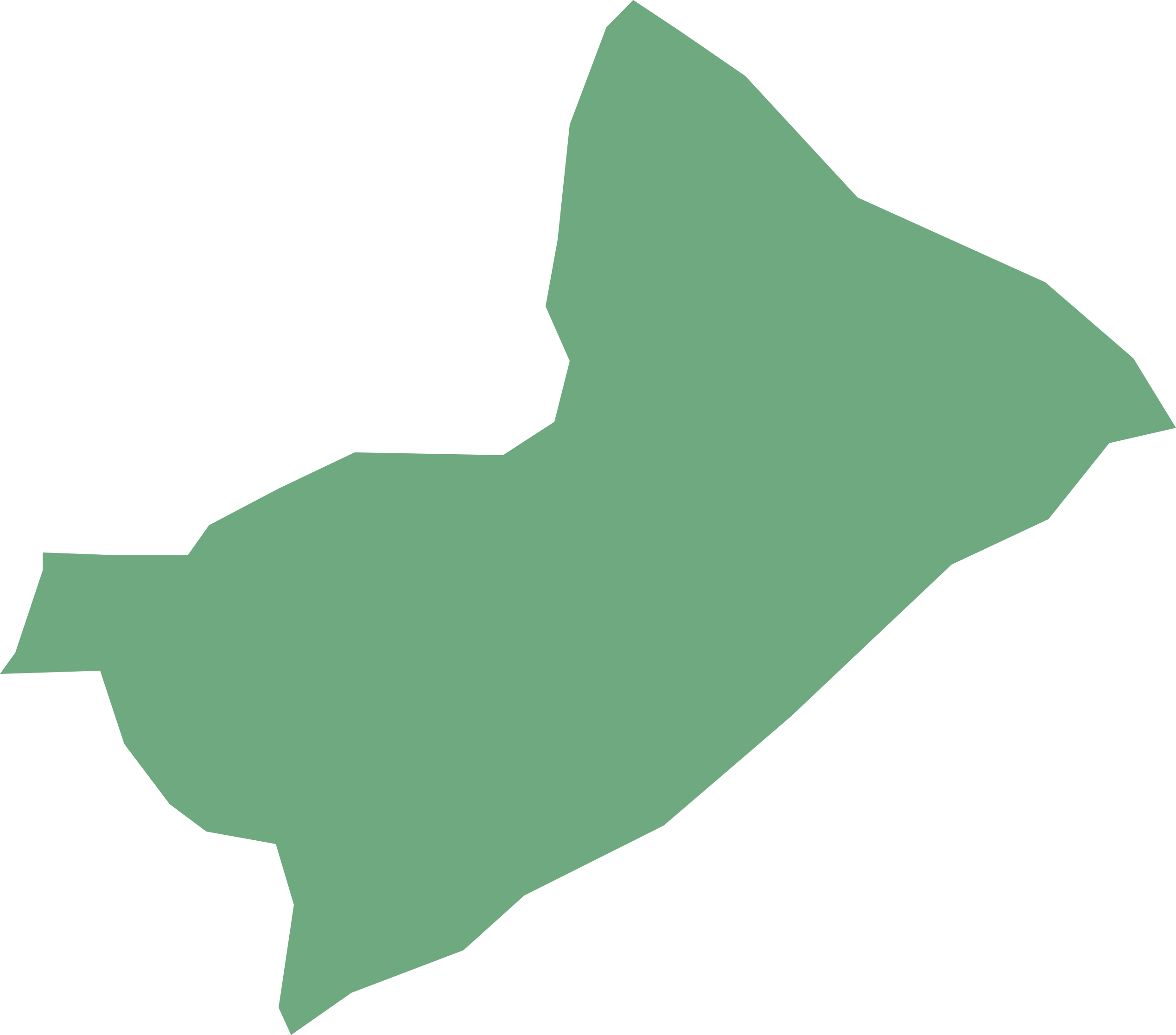
About Budgam District (Jammu & Kashmir)
Budgam district is a district of Jammu and Kashmir state with its administrative headquarters located at Budgam town. According to a famous chronicler named Khawaja Azam Demari long time back, the town Budgam was popularly known as Deedmarbag and also as Pargana Desu. Many of its natives believe, that because of the dense population it got its present name, Budgam meaning big village. In the earlier days, Budgam was a significant part of the Baramulla district, at that time Srinagar was a constituent of the Anantnag district. It was then well-known as Tehsil Sri Pratap. In the 11th centuy, the veteran warrior Mehmood Ghaznavi tried for two times to capture Kashmir through Punch Gali, the boundary of the current Budgam district. Gradually, the region came under the control of the Muslim rulers which lasted till the beginning of the 19th century. The district came into existence in 1979 but earlier it was a part of Baramula district.
Aga Syed Yousuf Al-Moosavi Al-Safavi, a notable Kashmiri religious scholar and the leader of Shia Muslims who founded the influential Anjuman-e-Sharie organisation was born at Budgam town in the year 1904.
Geographically, the district lies at 34°02'N Latitude, 74°79'E Longitude and 1610 m altitude. In the year 2023, there was a total 28.24% forest area of total geographical area. The district encompasses a geographical area of 1,250 sq km. and it is bounded by Baramulla district on the North and North West, Ganderbal district and Srinagar district on the North East, Poonch district on the South West, Shopian district on the South and Pulwama district on the East. The climate of the district is characterised as temperate type of climate. The actual rainfall in the district was 422.7 mm in the year of 2024-2025. Most of its rainfall occurs in the monsoon season.
Administration wise, the district is divided into 3 sub-divisions namely Beerwah, Chadoora and Khansahib. The district comprises 9 tehsils likewise Budgam, Beerwah, B.K.Pora, Chadoora, Charari Sharief, Khag, Khansahib, Magam and Narbal. Moreover, the district comprises 9 towns and 462 villages. The administrative language in the district is Urdu.
According to 2011 census the district has a population of 7,53,745 out of which 3,98,041 are males and 3,55,704 are females. The district has a sex ratio of 894 (females for every 1000 males. Furthermore, the district has projected population of 9,19,185 comprising 4,86,042 males and 4,33,143 females for the year 2026. According to the National Family Health Survey (NFHS-5, 2019–21), the district has an estimated sex ratio of 937 females and a child sex ratio of 917 females per 1,000 males. During the year 2001-2011 the population growth rate in the district was 19.77% including 22.08% were males and 17.29% were females. As per 2011 census the major religion in the district is Muslim with 97.65% of the total population. The population density in the district is 554 (persons per sq. km.). According to 2011 census the principal language in the district is Kashmiri with 94.78%. In the year 2023 the number of live births in the district was 11,380 out of which 6,080 were males and 5,300 were females. In the same year the number of deaths in the district was 2,480 out of which 1,963 were males and 517 were females.
The economy of Budgam is based on trading and agriculture. As Budgam is situated in the northern part of the state, the terrain here is more or less plain; a large section of the people living here, earns their livelihood by tilling their land. The major crops grown in the district are maize, rice and pulses. Besides these core crops, the region also produces vegetables like gourds, cabbage, cauliflower, potato, onion, brinjal, etc. The commercial initiatives by the farmers to cultivate these crops further helped the region to be known as the vegetable capital of Kashmir. Horticulture also contributes significantly in the economy of the district. Apple, pear, walnuts, and almonds are some of the major fruits grown in it. Animal husbandry is another important sector which helps in the economy of the region to a great extent. Most of the cattle owned in the district are of crossbreed variety. In addition to these sectors, handicraft is a well-known sector, especially the variety of Kani Shawls. In the year 2022-2023 the Gross Domestic Product in the district was Rs. 11,24,313 lakh at current price and Rs. 6,46,828 lakh at constant 2011-2012 prices. The Net Domestic Product in the district during the period 2022-2023 was Rs. 8,95,566 lakh at current price and Rs. 4,95,440 lakh at constant 2011-2012 prices. The Per Capita Income or NDDP, At Factor Cost in the district during the period 2022-2023 was Rs. 1,07,469 at current price and Rs. 59,453 at constant 2011-2012 prices.
The district is an abode of several reputed educational institutions. It provides a platform for higher education. As per 2011 census the literacy rate in the district is 56.08% out of which 66.3% are males and 44.85% are females. The total number of literates in the district is 3,35,649 including 2,07,741 are males and 1,27,908 are females. In addition, according to the Periodic Labour Force Survey (PLFS) for the period July 2023-June 2024 estimated literacy rate in the district is 73.19% including 81.48% are males and 64.48% are females (Age 7 Years and Above).
The district has several centres of attraction which allures many travellers from different parts of the country as well as world. Sheikh Noor-ud-Din Noorani’s tomb, popularly known as Alamdar-e-Kashmir, is situated at a distance of 28 km. in the southwest of Srinagar. The Shrine of Khan Sahib, associated with a famous saint, Hazrat Salen Khan is situated at the Khan Sahib block in the district. Imambara in Budgam, a prominent religious place draws almost all people of the of Shia community in the valley. Every year numerous pilgrims from far off places come to the Shrine of Hazrat Ganga Baba Rishi in order to offer their prayers. Yousmarg, a beautiful place situated 50 km. away to the southwest of Srinagar is surrounded by splendid trees in the lap of Pir Panjal mountain range. It is a perfect destination for nature’s lovers. Pony riding in the meadows here is a tourist's enchantment. The district is fortunate enough to have the world’s biggest chinar (one kind of tree).