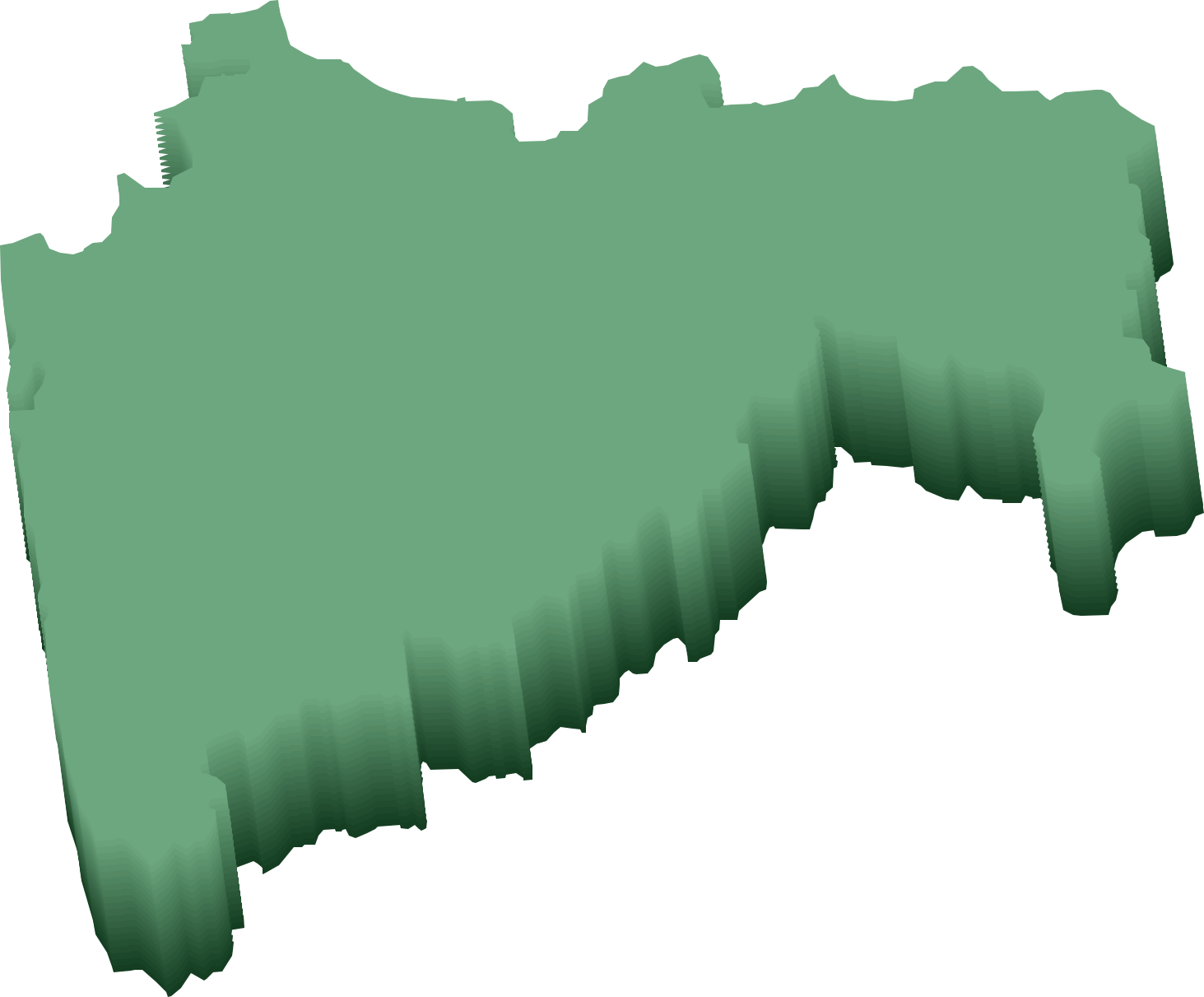
About Beed / Bid District (Maharashtra)
Bid district, a part of the Aurangabad division is a district of Maharashtra state with its administrative headquarters located at Bid city. There are two prominent traditions associated with the name of the place ‘Bid’. As per the first tradition, the district is situated at the foot of the Balaghat Rangeas if it is in a hole, hence the region wasnamed as Bil (meaning hole in Marathi) and with the passage of time it might have changed into ‘Bid’. According to the another or second tradition, once there was a Yavana,ruler of ancientIndianamed the place as‘Bhir’ (meaning water in Persian) after finding water here at a very low level also and in course of time the name of the place might have become ‘Bid’.Bid is a historically significant place which possibly has its medieval origin. But the early history of the district is quit vague. Historians believe that the city might have been founded by the Yadava rulers (1173-1317) of the region, Devagiri.During different periods of time the place was ruled by many different rulers and kingdoms. Bid, the head quarter’s city was popularly known as Champavati nagari in the ancient period. The old historical monuments of the district in the form of many city entry doors and city protection walls are proving its glorious history. During the period of British India, Bid was a part of the State of Hyderabad (Asaf Jahi Kingdom) of Nizams till the 19th century. But after a fierce struggle between Indian freedom fighters and Nizam soldiers, it became a part of the Indian Republic.On 1st May, 1960 Maharashtra state was created on linguistic basis and Marathi dominant Bid district became part of Maharashtra.
Geographically, the district lies at 18°99'N latitude, 75°76'E longitude and 457 m altitude. In the year 2023, there was a total 1.48% forest area of total geographical area. The district encompasses a geographical area of 10,693 sq km. and in terms of geographucal area it occupies the ranks of 11th in the state and 53rd in India. It is bounded by Aurangabad district and Jalna district on the North, Ahmednagar district and Osmanabad district on the South, Parbhani district and Latur district on the East and Ahmednagar district on the West. The climate of the district is characterized as semi-arid, hot and dry climate remains here throughout the year. Most of its rainfall occurs in the monsoon season. The actual rainfall in the district was 805.3 mm in the year of 2024-2025.
Administration wise, the district is divided into 11 tehsils namely Bid, Ashti, Gevrai, Ambajogai, Kaij, Parli, Majalgaon, Patoda, Shirur, Wadvani and Dharur. Moreover, it comprises 9 towns and 1,357 villages. The administrative language in the district is Marathi.
According to 2011 census the district has a population of 25,85,049 out of which 13,49,106 are males and 12,35,943 are females. The district has a sex ratio of 916 females for every 1000 males. Furthermore, the district has an estimated projected population of 31,52,441 comprising 16,47,426 males and 15,05,015 females for the year 2026. According to the National Family Health Survey (NFHS-5, 2019–21), the district has an estimated sex ratio of 934 females and a child sex ratio of 838 females per 1,000 males. During the year 2001-2011 the population growth rate in the district was 19.61% including 20.85% were males and 18.28% were females. The population density in the district is 242 persons per sq. km. In the year 2023 the number of live births in the district was 47,780 out of which 25,370 were males and 22,406 were females. In the same year the number of deaths in the district was 8,735 out of which 5,985 were males and 2,750 were females. As per 2011 census the major religion in the district is Hindu with 84.12% of the total population. According to 2011 census the principal language in the district is Marathi with 83.38%.
Agriculture is the backbone of the economy of the district. Most of the lands in the district are use for agricultural purposes. More than half of its population are engaged in agriculture in order to earn their livelihood. The chief agricultural products in the district are cotton, groundnut, wheat, sugarcane, cereals, pulses, etc. The adoption of the new agricultural technologies amongst the famers of the district helps to increase the production of various agricultural items. Every year a huge chunk of revenue comes from the agricultural products in the district helps in its economy to a great extent. But, the district is scantily industrialised. In the year 2023-2024 the Gross Domestic Product in the district was Rs. 56,31,900 lakh at current price and Rs. 33,18,700 lakh at constant 2011-2012 prices. The Net Domestic Product in the district during the period 2023-2024 was Rs. 49,92,800 lakh at current price and Rs. 29,12,200 lakh at constant 2011-2012 prices. The Per Capita Income or NDDP, At Factor Cost in the district during the period 2023-2024 was Rs. 1,77,240 at current price and Rs. 1,03,382 at constant 2011-2012 prices.
The district is well known as an abode of several reputed educational institutions. It provides a platform for higher education. Most of the colleges in the district are affiliated to the Dr. Babasaheb Ambedkar Marathwada University in Aurangabad. As per 2011 census the literacy rate in the district is 76.99% including 85.55% are males and 67.82% are females. In addition, according to the Periodic Labour Force Survey (PLFS) for the period July 2023-June 2024 estimated literacy rate in the district is 71.91% including 82.15% are males and 61.60% are females (Age 7 Years and Above).
Gopinathrao Pandurang Munde, a veteran Indian politician who served as the Deputy Chief Minister of Maharashtra from 14th March, 1995 to 11th October, 1999 was born on 12thDecember, 1949 at Nathra village, Parali in the district. He was a member of the Bhartiya Janata Party.
The district has several centres of attraction which allures many travellers from different parts of the country as well as world. Kankaleshwar Temple, one of the oldest and the most beautiful temples in the city which is most probably constructed during the Yadava period under the reign of Singhana(1210-47). Jama Masjid, situated at the heart of the city is one of the largest Masjids of the Bid city. It was constructed by the official of the Mughal emperor Jahangir during his reign in Bid. Shahinshah Wali tomb, a tomb of a great Sufi of the 14th century named Shahinshah Wali from the Chishtiya clan who came to Bid during the rule of Muhammad Tughluq. Some other places of interest in the district are Mansur Shah tomb, Historic Gates, Khandoba Temple, Khazana Well and many more.